
Wolf guide · 4 min read
Wolf oven baking unevenly in a Pleasant Hill kitchen? Start here
A Wolf oven that browns unevenly or runs hot is usually calibration or a tired sensor, not a dead control board. What it means and how it's diagnosed in Pleasant Hill kitchens.
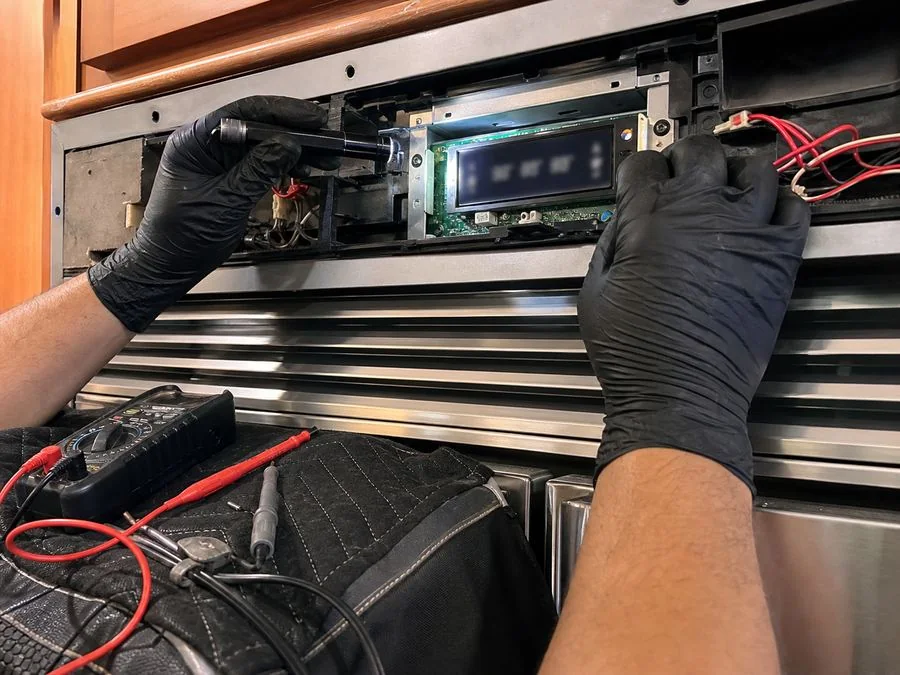
It's one of the more common Wolf cooking calls we get across Pleasant Hill and the neighboring Walnut Creek and Concord kitchens: the oven looks fine, lights fine, but the baking is off. One side browns faster than the other, a tray of cookies comes out scorched at the temperature that used to be perfect, or a roast finishes long before the timer says it should.
It feels like a major fault. It usually isn't. Wolf builds serious cooking equipment, and the things that throw off its bake are almost always at the diagnosable, repairable end of the scale.
Hot, uneven, or drifting — three different culprits
If the whole oven simply runs hot or cold by a consistent amount, that's calibration. Wolf ovens carry a temperature offset you can adjust, and over years of use — or after a move or a power event — that offset can drift so the dial and the real cavity temperature no longer agree. We confirm it with an independent probe thermometer, not the oven's own readout, before touching anything.
If the oven overshoots and undershoots erratically, the temperature sensor (the thin probe inside the cavity) is the usual suspect; they degrade and start feeding the control bad readings. And if one side browns faster than the other on convection, the culprit is often a tired convection fan motor or a relay that isn't reliably kicking the fan on — not the whole control board, which is the expensive part people fear and rarely the actual fault.
What the fix actually looks like
A pure calibration drift is the cleanest outcome — we recalibrate the offset, verify it across a full heat cycle with our own thermometer, and you're done the same visit. A failed sensor is a bounded swap with a genuine OEM part. A convection issue comes down to testing the fan motor and the relay and replacing only the piece that failed.
The principle is the same one we apply to every Wolf cooking call: test before replacing, so you never pay for a guessed-at control board. The $89 diagnostic goes toward the repair, and the work carries our 365-day warranty. Call (925) 940-3576 or book a window online.
FAQ
Questions & answers
Is an off-temperature Wolf oven a control-board problem?
Rarely. Most uneven or hot-running Wolf ovens come down to a drifted calibration offset, a tired temperature sensor, or a convection fan or relay — all far cheaper than a control board. We test with an independent thermometer and replace only the part that's actually failed.
Can I recalibrate the oven myself?
Wolf does expose a temperature offset in the controls, and minor tweaks are owner-adjustable. The catch is knowing the true cavity temperature first — without an accurate probe you can calibrate to a wrong target. If the drift is large or erratic, that points to a sensor rather than a setting.
Does Wolf also make the refrigerator in my kitchen?
No — Wolf builds cooking equipment: ranges, ovens, cooktops and ventilation. The built-in refrigeration is its sister brand Sub-Zero, which we also service.
Guides
More Pleasant Hill guides
- Wine storage guide · 6 min Why a Sub-Zero wine column drifts warm in Pleasant Hill A Sub-Zero wine column that creeps above its set point in a hot inland Pleasant Hill kitchen is usually airflow, a dual-zone sensor, or a tired seal — not a dead compressor. What goes wrong and how it's diagnosed. Read the guide →
- Seasonal guide · 5 min What a Pleasant Hill summer does to a built-in Sub-Zero Inland Diablo Valley heat pushes a built-in Sub-Zero harder than the coastal Bay. What the dry 95-degree afternoons do to the condenser, and the one habit that prevents most July breakdowns. Read the guide →
- Decision guide · 7 min Repair or replace a Sub-Zero during a Pleasant Hill remodel Many Pleasant Hill kitchens have a 15-to-20-year-old built-in Sub-Zero hitting the remodel decision. A cost-and-evidence framework for keeping it, fixing it, or letting it go. Read the guide →
Rather leave it to a specialist?
Call the Pleasant Hill desk for diagnostic-first booking and a clear price before any work begins.