
Seasonal guide · 5 min read
What a Pleasant Hill summer does to a built-in Sub-Zero
Inland Diablo Valley heat pushes a built-in Sub-Zero harder than the coastal Bay. What the dry 95-degree afternoons do to the condenser, and the one habit that prevents most July breakdowns.
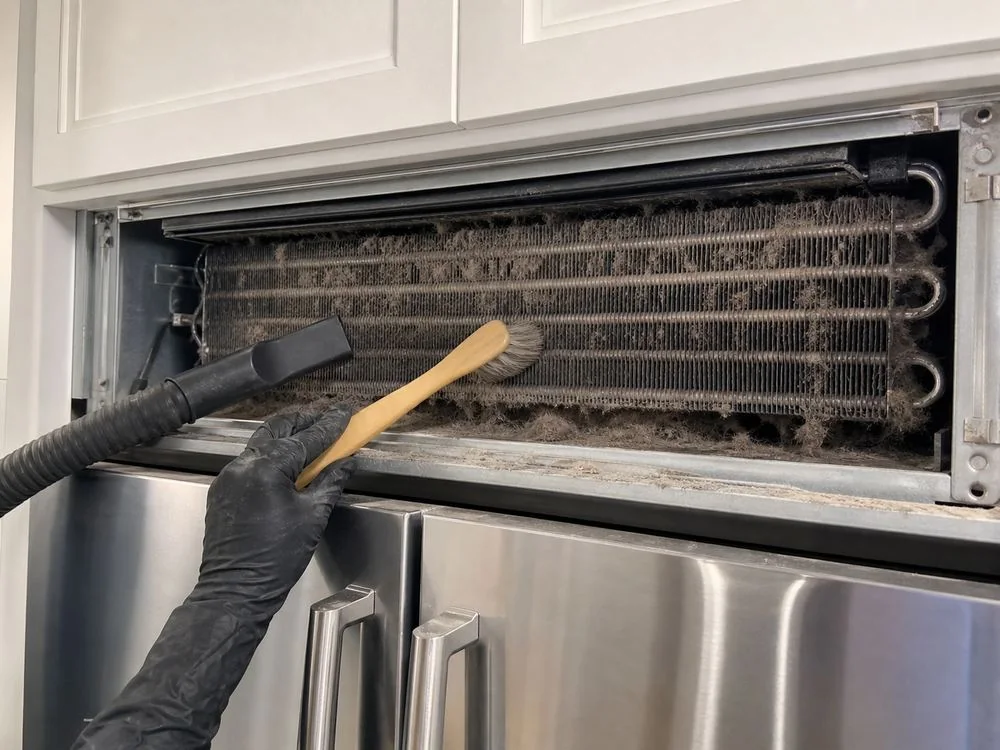
Pleasant Hill sits in the inland crook of Contra Costa County, in the Diablo Valley shadow of Mount Diablo, where summer behaves nothing like it does over the hills in San Francisco. Afternoons in July and August routinely sit in the mid-90s and the air is bone dry, and that combination is the single biggest reason we get a run of cooling calls every year once the heat settles in.
A built-in Sub-Zero is a sealed, precision machine, but it still has to dump the heat it pulls out of your food into the room around it. When that room is a closed-up kitchen on a 98-degree afternoon, the margin gets thin. Here is what actually happens, and the one bit of upkeep that prevents most of it.
Dry inland air bakes dust onto the condenser
Unlike the foggy coast, Pleasant Hill summers are dry and dusty — gardens go brown, the Mount Diablo foothills turn gold, and fine dust drifts indoors all season. A built-in Sub-Zero pulls room air across its condenser coil (behind the upper grille on most models) to shed heat, and in a dry inland kitchen that air arrives loaded with lint and dust that cakes onto the coil.
A clogged coil can't release heat efficiently. The compressor compensates by running longer and hotter, and on the hottest week of the year that's exactly when a marginal unit tips over from 'running a little warm' into 'not holding temperature at all.' We see the same homes call in August that sailed through the mild spring without a hiccup.
A hot kitchen narrows the safety margin
Sub-Zero rates its sealed systems to hold temperature in a normally air-conditioned room. Push the ambient up into the high 80s or 90s — a west-facing Pleasant Hill kitchen with the afternoon sun on it, or a remodel that put the fridge next to a Wolf range that's been on all evening — and the system has to work harder for the same result. A unit with a tired gasket, a slightly low charge, or a half-clogged coil will cope in winter and fail in the heat.
It's worth keeping the area around the grille clear, not crowding the unit into a tight cabinet run, and running the kitchen's own ventilation when you're cooking on a hot day.
The one habit that prevents most July breakdowns
Clean the condenser before summer, not after it fails. Once a year — ideally in late spring before the first heat wave — the coil should be vacuumed and brushed and the gasket checked for a clean seal. It's the highest-value thing a Pleasant Hill owner can do, and it's far cheaper than the emergency sealed-system call a neglected coil eventually invites in the middle of a 100-degree week.
If you'd rather have it done properly, our maintenance visit covers exactly this. The $89 diagnostic goes toward any repair, and the work carries our 365-day warranty on parts and labor. Call (925) 940-3576 or book a window online.
FAQ
Questions & answers
When is the best time to service a Sub-Zero in Pleasant Hill?
Late spring — March through May — before the first inland heat wave. Cleaning the condenser and checking the gasket then means the unit goes into the hottest months with full cooling margin instead of catching up after a breakdown.
Does the inland heat really matter compared to the coast?
Yes. Pleasant Hill summers run far hotter and drier than coastal San Francisco, so the condenser loads with dust faster and the sealed system works closer to its limit on hot afternoons. Preventive cleaning pays off faster here than it does near the Bay.
Can I clean the condenser myself?
You can vacuum the grille area, which helps. A full clean means pulling the grille and carefully brushing the coil without bending the fins, plus a gasket and airflow check — that's where a once-a-year professional visit earns its keep.
Guides
More Pleasant Hill guides
- Wine storage guide · 6 min Why a Sub-Zero wine column drifts warm in Pleasant Hill A Sub-Zero wine column that creeps above its set point in a hot inland Pleasant Hill kitchen is usually airflow, a dual-zone sensor, or a tired seal — not a dead compressor. What goes wrong and how it's diagnosed. Read the guide →
- Decision guide · 7 min Repair or replace a Sub-Zero during a Pleasant Hill remodel Many Pleasant Hill kitchens have a 15-to-20-year-old built-in Sub-Zero hitting the remodel decision. A cost-and-evidence framework for keeping it, fixing it, or letting it go. Read the guide →
- Wolf guide · 4 min Wolf oven baking unevenly in a Pleasant Hill kitchen? Start here A Wolf oven that browns unevenly or runs hot is usually calibration or a tired sensor, not a dead control board. What it means and how it's diagnosed in Pleasant Hill kitchens. Read the guide →
Rather leave it to a specialist?
Call the Pleasant Hill desk for diagnostic-first booking and a clear price before any work begins.