
Wine storage guide · 6 min read
Why a Sub-Zero wine column drifts warm in Pleasant Hill
A Sub-Zero wine column that creeps above its set point in a hot inland Pleasant Hill kitchen is usually airflow, a dual-zone sensor, or a tired seal — not a dead compressor. What goes wrong and how it's diagnosed.
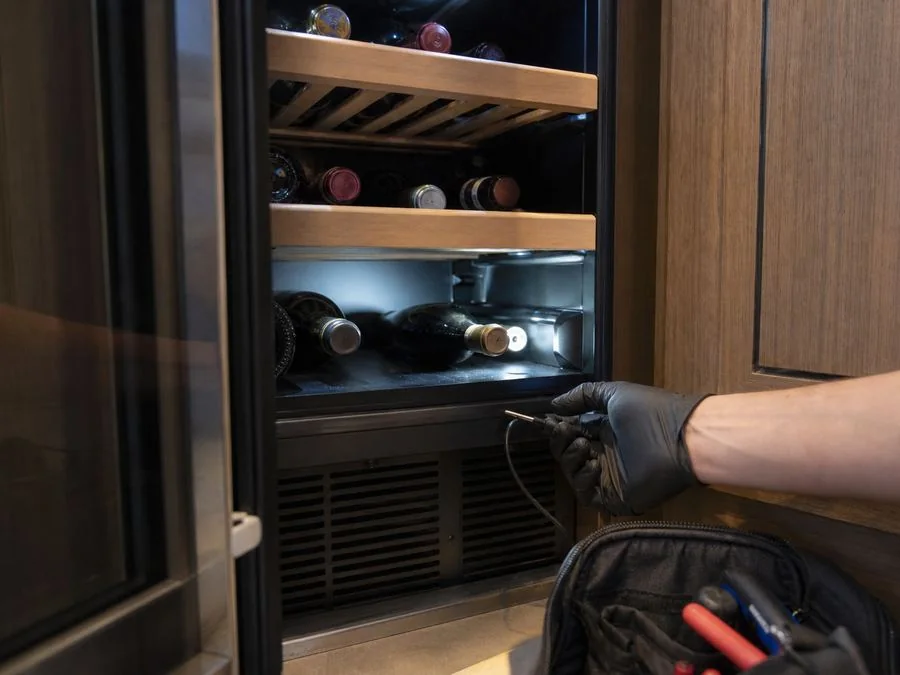
Of all the Sub-Zero equipment we service in Contra Costa County, the built-in wine storage is the one that quietly suffers most in a Pleasant Hill summer. A refrigerator failing announces itself — milk spoils, ice stops. A wine column drifting two or three degrees warm says nothing at all until a collection that should have aged for a decade has been cooking at cellar-plus temperatures through August.
Sub-Zero does build serious wine storage — dual-zone columns and undercounter units engineered to hold separate reds-and-whites temperatures and the steady humidity a cork needs. That precision is exactly what makes a small fault matter. Here is what tends to go wrong on the inland East Bay side of the Caldecott, and how we run it down.
Dual-zone drift: the fault you taste before you read it
The defining feature of a Sub-Zero wine unit is independent upper and lower zones — typically a warmer red zone over a cooler white zone, each governed by its own thermistor and damper. When one zone creeps off target, the cause is usually the zone sensor feeding a drifted reading or a damper that no longer modulates cleanly, not the sealed system. A column that reads 55 on the display while a probe inside shows 61 is a classic mismatched-sensor signature, and in a Pleasant Hill house where the kitchen already runs warm on a 96-degree afternoon, that hidden gap is enough to age a bottle wrong over a season. We verify both zones with an independent thermometer before condemning any part.
Inland heat, loaded condensers and a hard-working seal
A wine column sheds its heat the same way a built-in fridge does — through a condenser coil behind the grille — and the dry, dusty Diablo Valley air around Gregory Gardens and the streets off Contra Costa Boulevard cakes that coil faster than the foggy coast ever would. A loaded condenser makes the compressor run long and warm, and the first place that shows is the zone that has to fight the room. The door is the other inland pressure point: a Sub-Zero wine unit relies on a tight gasket and UV-tinted glass to hold humidity and block light, and a gasket that has gone stiff with age lets warm kitchen air leak in all afternoon. We check coil loading, gasket seal and the glass seal together, because in this climate they fail as a set.
Vibration, the evaporator fan, and when it's worth fixing
Two more failures round out the wine-storage list. A noisy or failing evaporator fan stops circulating cold air evenly, so one shelf sits warmer than the next — the same uneven-cooling complaint we hear on refrigerators, just with higher stakes for what's inside. And vibration matters in a way it doesn't for groceries: a worn fan mount or a compressor sitting on tired isolators transmits a constant tremor that disturbs sediment and tires a cork over years, so a unit that has grown buzzy is worth addressing on its own.
Almost all of this is a bounded, worthwhile repair on a unit Sub-Zero built to last — a sensor, a damper, a gasket, a fan, a condenser clean. The expensive fork is the sealed system, and there we put gauges on it and show you the readings before recommending anything. The $89 diagnostic goes toward the repair, the work carries our 365-day warranty on parts and labor, and we are an independent service — not a factory-authorized depot. Call (925) 940-3576 or book a window online.
FAQ
Questions & answers
My Sub-Zero wine cooler shows the right number but the wine feels warm. What's wrong?
That display-versus-reality gap is the most common dual-zone fault — usually a drifted zone thermistor or a damper that isn't modulating, so the unit believes it's at temperature when it isn't. We confirm it with an independent probe in each zone before replacing anything, because the sensor and the sealed system call for completely different fixes.
Does Pleasant Hill's inland heat affect a wine unit more than a regular fridge?
It can, because the stakes are slower and quieter. The condenser loads with dry inland dust the same way, but a wine column drifting a few degrees warm spoils a collection over months without any obvious sign, where a fridge tells you immediately. A late-spring condenser clean and gasket check is the cheapest protection here.
Is a Sub-Zero wine cooler usually worth repairing?
Yes, in most cases. The common faults — a zone sensor, damper, gasket, evaporator fan or a clogged condenser — are bounded repairs on a unit engineered to run for years. Only a major sealed-system failure on an older unit tips the math toward replacement, and we show you the gauge readings behind that call rather than guessing.
Guides
More Pleasant Hill guides
- Seasonal guide · 5 min What a Pleasant Hill summer does to a built-in Sub-Zero Inland Diablo Valley heat pushes a built-in Sub-Zero harder than the coastal Bay. What the dry 95-degree afternoons do to the condenser, and the one habit that prevents most July breakdowns. Read the guide →
- Decision guide · 7 min Repair or replace a Sub-Zero during a Pleasant Hill remodel Many Pleasant Hill kitchens have a 15-to-20-year-old built-in Sub-Zero hitting the remodel decision. A cost-and-evidence framework for keeping it, fixing it, or letting it go. Read the guide →
- Wolf guide · 4 min Wolf oven baking unevenly in a Pleasant Hill kitchen? Start here A Wolf oven that browns unevenly or runs hot is usually calibration or a tired sensor, not a dead control board. What it means and how it's diagnosed in Pleasant Hill kitchens. Read the guide →
Rather leave it to a specialist?
Call the Pleasant Hill desk for diagnostic-first booking and a clear price before any work begins.